

The Least Sensible OPTION
“OF THE THREE OPTIONS, MOTOR RACING MADE THE LEAST SENSE.”
The rain could not make up its mind.
It had begun as a cold but pleasant Sydney winter day before settling into something grey, wet and miserable. Sometimes it rained lightly. Sometimes it rained properly. Mostly it simply threatened to do one or the other.
By lunchtime, I had three choices.
I could go to the SCG to watch the Sydney Swans. Tickets were still available and, if I was willing to pay enough, I could sit undercover. I could stick with my original plan and head to Rockdale to watch Manly United play Sydney FC, although the walk from the station was becoming less appealing with every shower.
Or I could go to Sydney Motorsport Park.
That was clearly the least sensible option. Eastern Creek isn't the easiest place to reach by public transport. The venue is exposed, the circuit would be wet and, unlike most of the motorsport I'd watched before, I had no real idea what sort of racing I was about to see.
It felt like a gamble. So, naturally, I chose the motor racing.
The Open Door
The decision came down to curiosity. Opportunity merely removed the excuses.
An old friend was racing in one of the categories at the Hi-Tec Oils Super Series. I hadn't seen him for a while, so there was a chance to watch him race and perhaps catch up afterwards.
Then a colleague mentioned she was going too. Her seventeen-year-old nephew was racing a Legend Car, and she offered me a lift.
The difficult trip to Eastern Creek had suddenly become easy.
That first open door led to another. My colleague had access to the paddock through her nephew's team and, because I'd arrived with her, I found myself welcomed in as well. Instead of buying a ticket and watching anonymously from the grandstand, I was standing in a garage meeting the young driver, his parents and the little car they'd built to race.
I'd gone hoping to see one person I knew.
Within minutes, I was asking questions of a father who somehow seemed to be mechanic, engineer, organiser and problem-solver all at once.
This was a side of grassroots motorsport I had never really seen.
A Family Car
The Legend Car looked almost like a toy until I leaned closer.
It was a five-eighths-scale replica of an American coupe from the 1930s, built around a tubular frame and powered by a 1250cc Yamaha motorcycle engine. Small car, large tyres, very little wasted space.
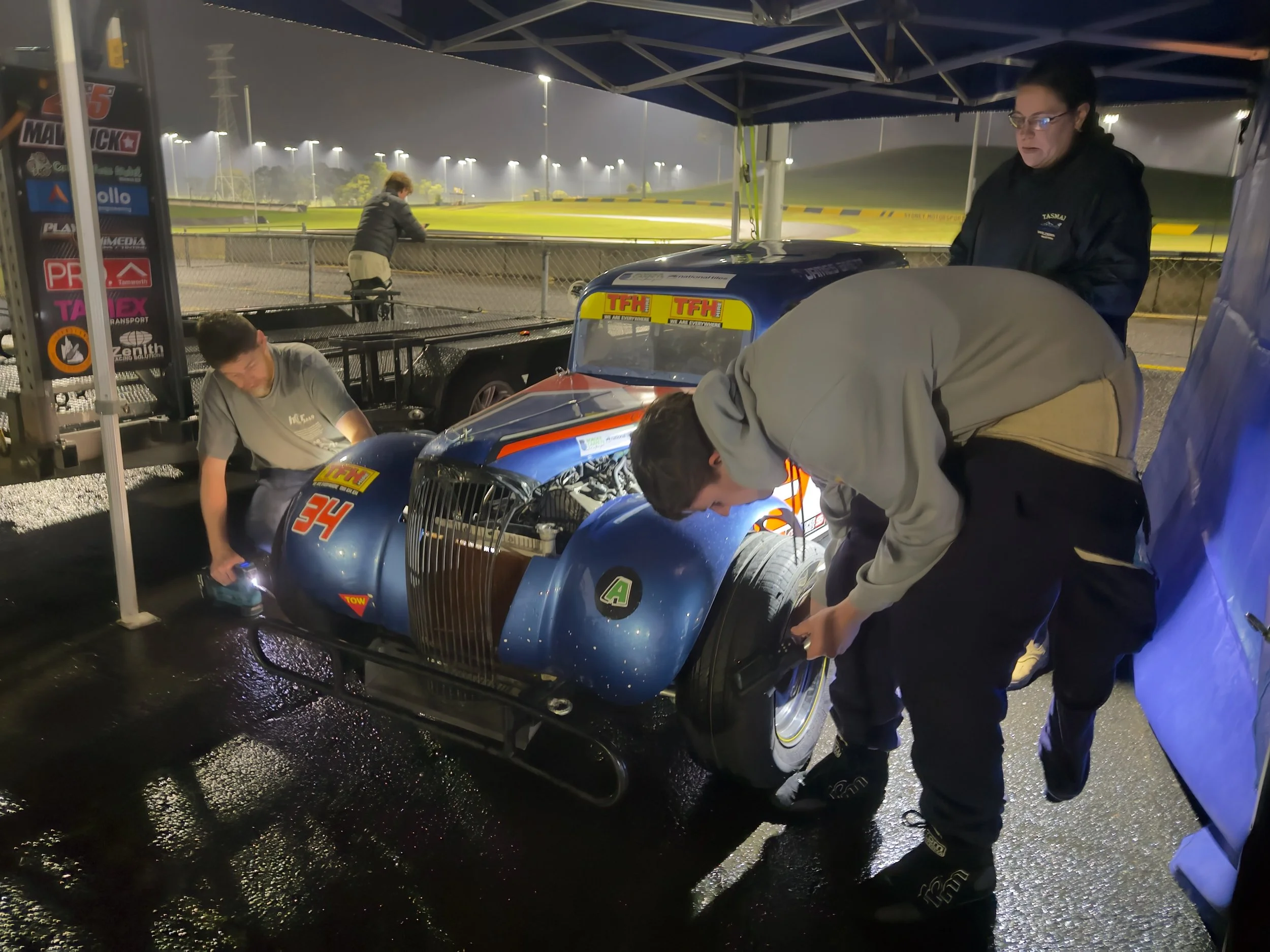
It made sense when I was told that drivers often progress into these cars from karting. They reminded me of oversized go-karts.
What interested me most was not the specification. It was the family surrounding it.
Across the paddock, parents, partners, siblings, friends and family businesses had become race teams. Wheels came off. Tools came out. People disappeared beneath bodywork. Someone always seemed to be tightening, adjusting or discussing something.
At the professional end of motorsport, teams can feel like corporations. Here, the boundary between family and race team barely existed.
Motorsport is not cheap, even in a category designed to control costs. Walking through the paddock, you could almost see the spectrum. Some families looked as though they were doing it on the smell of an oily rag, making every dollar count. Others appeared able to replace almost anything without hesitation. I couldn't help wondering how much of the difference came from the driver and how much came from the car. From conversations around the paddock, it seemed money could buy lots of small advantages. On their own they might not matter much. Add enough of them together and perhaps they become a faster racing car.
But every garage contained some version of the same ritual. People had brought a car to Eastern Creek and were trying to make it faster, safer or simply ready for the next race.
An Angry Herd of Hornets
The rain had mostly stopped by the time we went outside, although the circuit was still soaked.
I did not sit in the grandstand. Instead, I stood on the roof of the main building, looking down the start-finish straight towards the first corner. The slower cars were still arriving at close to 180 kilometres an hour. The faster ones were nearer 220.
From television, a corner can look like a line on a circuit map. From the roof, in the wet, it looked like a decision.
Drivers picked a braking point, committed to a line and trusted that the tyres would hold. When three cars arrived bumper to bumper, perhaps half a metre apart, they weren't just trusting their own nerve. They were trusting their equipment, the driver ahead, the driver behind and whoever was trying to squeeze alongside them.
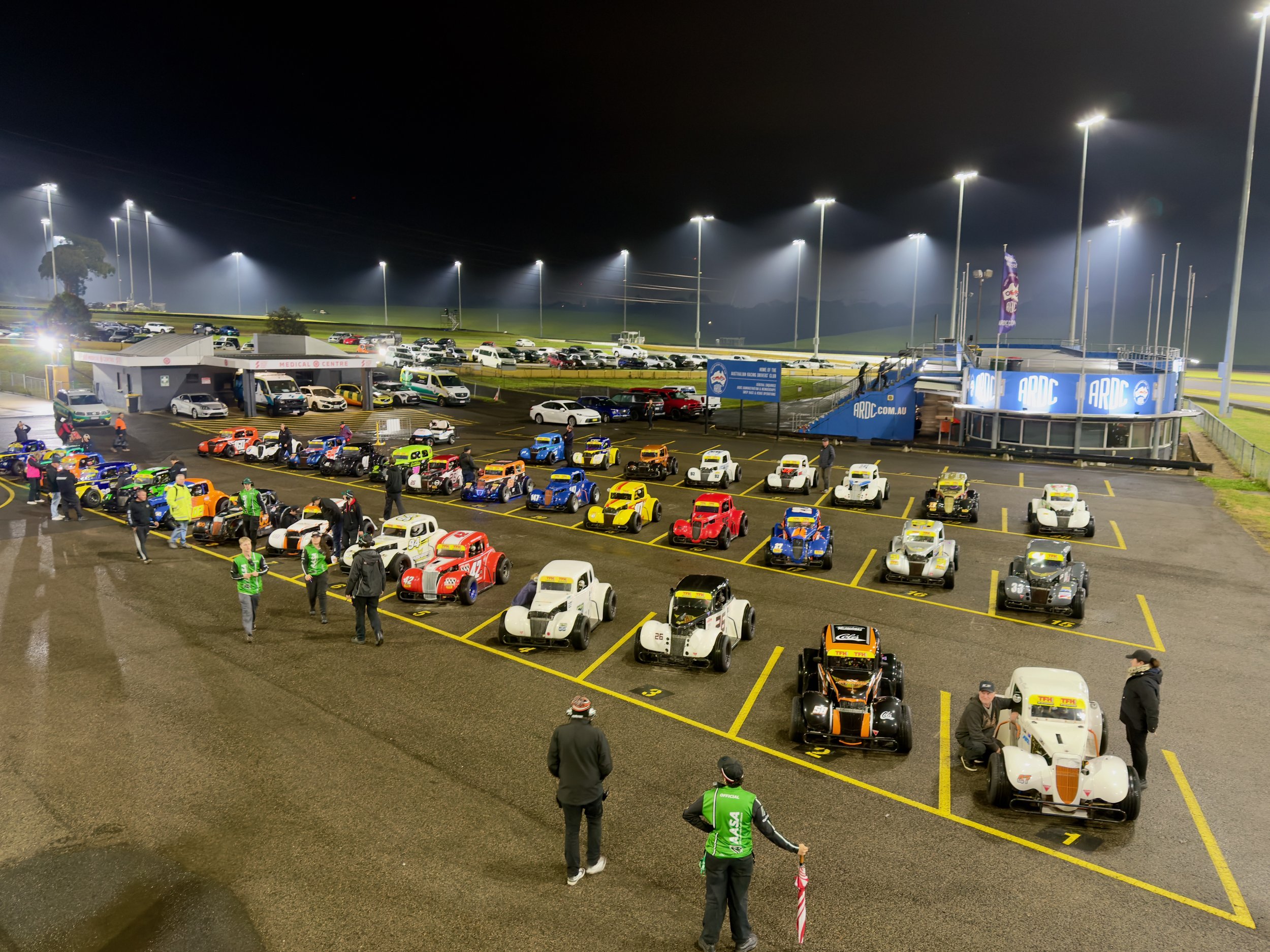
The Legend Cars were my highlight.
More than thirty of them charged towards the first corner together. Their motorcycle engines produced a completely different sound to everything else on the program. The larger cars roared. The Legends screamed. In a pack they sounded like an angry herd of hornets chasing each other around Eastern Creek.
They raced hard. Two and sometimes three cars ran side by side through wet corners. The field was large enough that battles developed everywhere. These were not enormous, sophisticated machines floating past one at a time. They were compact, noisy and constantly in one another's way.
The wet track punished even small mistakes. A wheel dropped onto the grass and the car often became a passenger. Eastern Creek's saturated ground swallowed almost everything that left the bitumen. One driver somehow dug his way back to the track like a tractor. Most had to wait to be recovered.
That led to frequent appearances from what the event insisted on calling the pace car. I had always called it a safety car. Perhaps pace car is the more accurate name. It certainly spent enough time pacing everyone around.
Every Sense
Motor racing does not always make a persuasive argument on television.
Cars travel in circles. A field can spread out. What begins as a contest can become a procession.
At the circuit, that is only part of what is happening.
There is the sound of engines arriving before the cars come back into view. There is the smell of fuel in the marshalling area and hot machinery in the garages. There are drills, rattles and metallic knocks from people pulling wheels and engines apart. Some of the exhaust fumes were strong enough that smell became taste.
Then one race finished and another category was already lining up. Formula cars, sports compacts, TA2 muscle cars and a mixed collection of high-performance cars all made different noises and behaved differently under braking. There was barely time to decide whether the previous race had been good before the next group rolled onto the circuit.
This was a live televised event, broadcast nationally on SBS Viceland, Fox Sports and Kayo. That professional coverage was also shown on the big screens around the venue.
What surprised me most was how much television and being there complemented each other rather than competed. Standing on the roof, I could follow the cars through the sections of circuit I knew, then glance at the big screen for the drone shots, in-car cameras and corners hidden from view. Rather than pulling me away from the circuit, the screen filled in the pieces I was missing.
It was a strange combination. The broadcast explained the race, but the circuit explained why it mattered.
A Familiar Place in a Different Light
Sydney Motorsport Park was not new to me. Years ago, when I photographed cycling, clubs used the circuit for races on weeknights and weekends. I have walked almost every part of it. I have photographed from corners, embankments, concrete walls, rooftops and, occasionally, places where I probably should not have been standing. I must have walked the circuit forty or fifty times.
That history meant I could follow the cars even when I could not see them. I knew where they were as they disappeared behind the rise, curled around the back of the circuit and returned towards the main straight.
I wasn't learning the circuit. I was rediscovering it from a completely different perspective. But I had never seen the place at night.
Under lights, with the wet surface reflecting headlights and track lighting, it became a different venue. The same corners I knew from slow-moving bicycles now demanded commitment from racing drivers at speeds that were difficult to comprehend from only a few metres away.
It was also nice to return without having to work.
Photography never really felt like work, but it was still a job. I had to think about position, light, angles and whether I had captured what I needed. This time I could stand on the roof and simply watch.
For once, I did not need to find the best view of the event. I only needed to be in it.
The Least Sensible Option
I thought I knew Sydney Motorsport Park. I knew its corners, its sightlines and the places a photographer could stand. What I'd never really seen was the family world inside its garages.
That only happened because I accepted a lift from a colleague. One opportunity led to another until I found myself somewhere I would never have reached on my own.
I almost chose one of the safer options.
Instead, I chose the gamble.
It reminded me that the best days don't always begin with the best plans. Sometimes they begin because someone opens a door, and you're curious enough to walk through it.
By the time I got home, I was already wondering whether I should come back the next day.