

Different
Different
I was still wondering whether I had chosen the right event when I arrived at Leichhardt Oval.
There had been other possibilities for the afternoon, and I had spent enough time thinking about them that the decision had followed me through the gate. I was not particularly attached to any of the four teams I was about to watch. I knew my way around rugby, but I had no reason to care deeply who won either grand final. It was also extraordinarily hot for early September.
That at least made one decision easy. I found a seat high in the grandstand, underneath the roof and out of the sun. On the other side of the ground, some of the University supporters had taken a different approach. Shirts were off and they were sitting in the direct sunlight, apparently prepared to bake through their grand final. They had plenty to make noise about.
The B-grade grand final, between University and Randwick, was open almost immediately. The points kept coming, and for a final it felt unusually loose. Tries kept changing the mood around the ground. One group would have its turn, then the other, and the score continued climbing all the way to University's 47–33 win.
I had arrived as a neutral and remained one, but that hardly mattered when the game kept giving me something to react to. There was also enough conversation around me to make clear how closely people followed this level of rugby.
They knew the players. They talked about who was playing well, selections and where people had come from. At one point there was discussion about Tom Gee, who had spent much of the season playing fourth grade before injuries pushed him rapidly through the grades. He would later score the opening try in the first-grade grand final.
What interested me was less the fact itself than how readily the people around me understood its significance. They knew where he had been playing, how unusual the progression was and what it meant to see him now appearing at this level.
Then the B-grade grand final finished and the ground began to change. University and Randwick had had their afternoon. Their supporters celebrated, absorbed the result and began to disappear. Seats opened around the ground. Other people were arriving.
Green and white began to belong to Warringah. Eastern Suburbs brought large flags, a drum and their own concentration of support. People moved in and out of the corporate areas behind me. Seats that had belonged to one group for the B-grade grand final acquired different occupants for the first-grade grand final.
It was the same oval, on the same afternoon, but it no longer felt like quite the same crowd. I still could not decide whether I wanted anyone to win. There were possible connections if I went looking for them, but none was strong enough to matter much. Eventually I stopped trying.
By the time first grade was ready to begin, it did not seem to matter. The noise had changed.
It was not one particular chant or cheer. There was a continuous buzz around the ground, the sound of a large group of people waiting for something important to begin. The earlier final had produced an engaged crowd. This was different. For the first time that afternoon, I stopped wondering whether I should have gone somewhere else.
Then the rugby started.
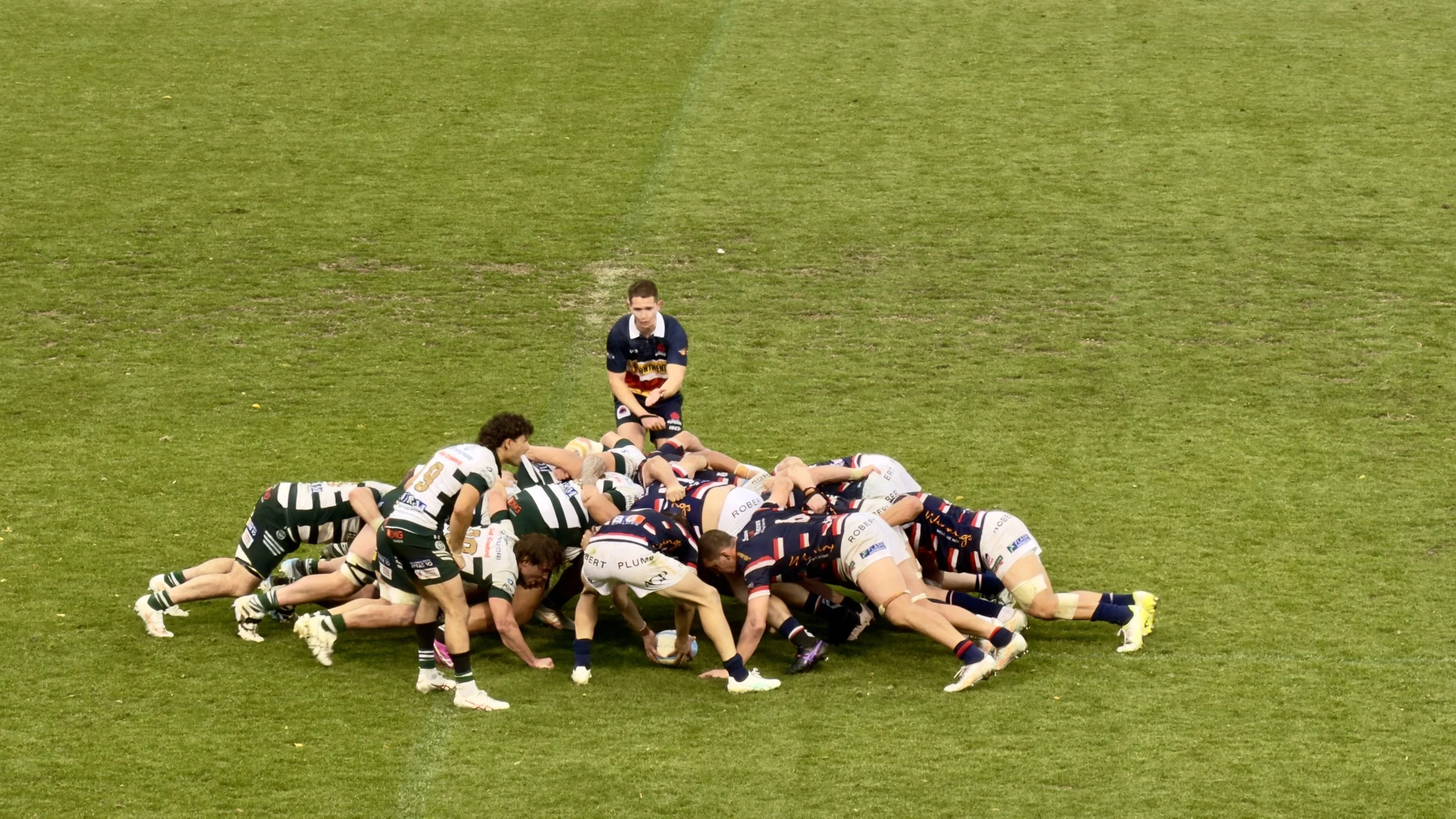
The first-grade grand final was almost the opposite of what had come before it. Eastern Suburbs were controlled, and the game became more calculated and forward-heavy than the University-Randwick final. There were passages where I admired what Easts were doing more than I enjoyed watching them do it.
The crowd compensated. Every decision could produce noise from somewhere. A cheer from one section might meet boos from another. A good passage brought me into it regardless of who had produced it.
Twice during the afternoon, kicks struck the posts. Both times the response seemed almost automatic. A rugby ball hitting an upright is unusual enough to draw the same immediate reaction from people all around the ground, regardless of which side they wanted to score.
It was one of the advantages of sitting among people who knew the game. They did not need to be told when something unusual had happened.
The weather, meanwhile, had started changing too. The heat that had made the roof above my seat so valuable began to give way to wind. Dark clouds came across the ground. High kicks started being grabbed by the strengthening breeze. Rain arrived, disappeared and came back again.
By the second half, the afternoon I had dressed for no longer seemed to exist.
The playing surface was already worn and patched. With rain on it, players began dealing with something more slippery as well. The wind was strong enough that I wondered how much responsibility it deserved for the missed kicks, although from the grandstand there was no way of knowing exactly what the kicker was dealing with at ground level.
Warringah missed all three of their conversion attempts. Eastern Suburbs kept control of the game. The crowd never really lost its energy.
The B-grade grand final had given me the more entertaining rugby: open, high-scoring and willing to keep changing. The first-grade grand final gave me the stronger sense of occasion. By the end, Eastern Suburbs had won 31–15.
Then whatever control had existed disappeared remarkably quickly.
There had been repeated instructions for spectators to stay off the field after the siren. There was apparently somewhere people were supposed to gather, although not everyone seemed particularly interested in the distinction. People started coming onto the ground.
At first it looked manageable. Then there were more of them. Some came through openings. Others came over fencing. The announcer had to clarify that people were being asked to leave the field, not come onto it. That did not seem to help much. Soon the players were surrounded.
The neat sequence expected after a grand final — players, interviews, presentations, supporters watching from the other side of a boundary — had dissolved into people everywhere. I did not stay to see how they eventually sorted it out.
Outside the ground, the weather had made its own alterations.
I headed towards the light rail and discovered that part of it was not operating. Trees had come down during the storm and services had been interrupted between stations. So I went looking for a bus. That got me into the city.
Central was busy for reasons that had little to do with the rugby I had just left. Among the disrupted passengers were plenty of Sydney Swans supporters coming away from their game against Brisbane, now being funnelled into the same transport problems as everyone else. Some train services had also been affected by the storms.
The trip home became slow and frustrating rather than disastrous. I was never stranded, but the disruptions added about an hour to a journey that should have been straightforward. It was enough to change one last plan.
I had intended to go into the office and do some work before heading home. By then I was tired of rearranging the day around things that had rearranged themselves first. I went straight home instead.
The afternoon had started in fierce sunshine. One grand final had become another. One crowd had left and another had arrived. The rugby had changed character. The wind had come up, the rain had arrived, supporters had ended up on the field and the storm had followed me into the trip home.
I still did not have a Shute Shield team. I was not suddenly planning weekends around club rugby either.
But I had stopped wondering whether I had chosen the right place to be.