Do clothes make the fan?
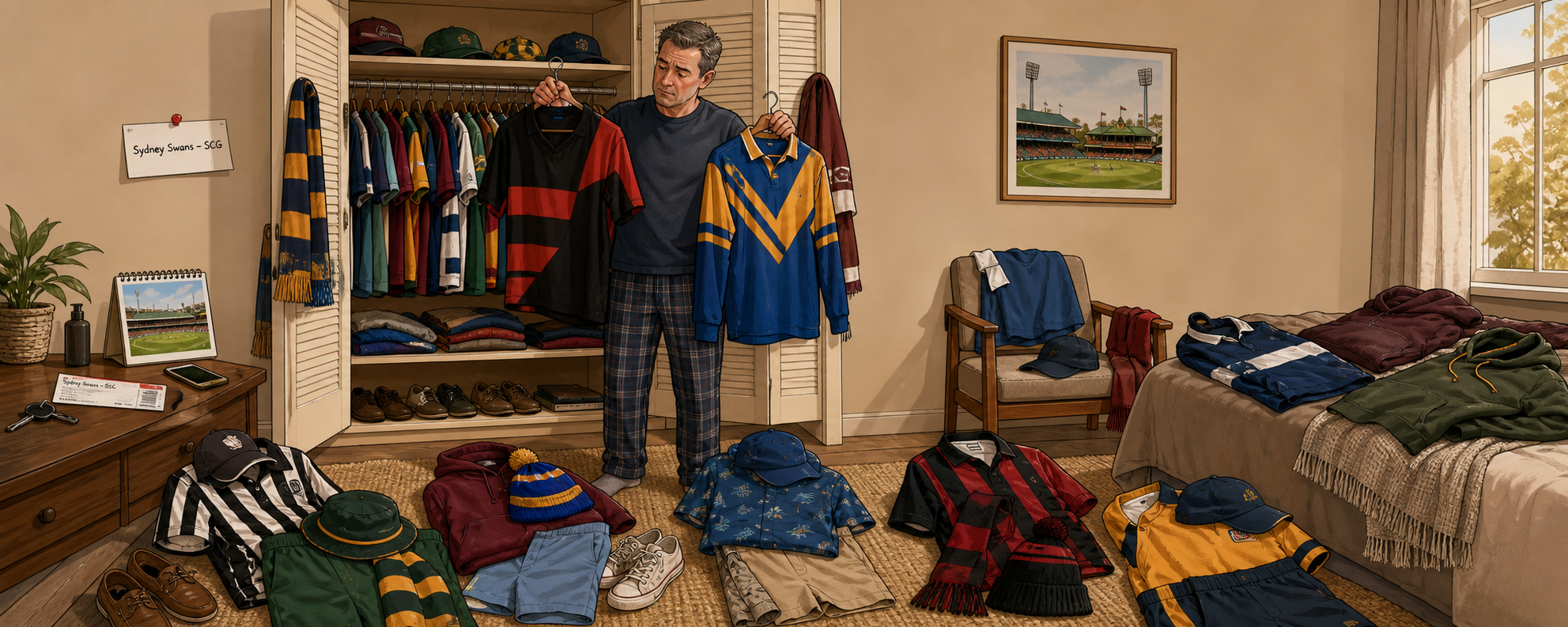
I went to Rockdale to support Manly United and accidentally dressed as a Rockdale Ilinden supporter.
The mistake
It was an away game for Manly, played at Rockdale’s ground. I had put on a red T-shirt and a black jumper without giving either much thought. They were simply clothes when I left home. By the time I arrived, surrounded by Rockdale’s black and red, they had become a declaration.
Anyone looking at me could reasonably have assumed I supported the home team. I knew why I was there. My clothes appeared to have reached a different conclusion.
Nobody cared. There was no steward checking colours at the gate and my shirt was not going to change the result. But it made me suddenly aware of something I had previously given very little thought.
What we wear to sport says something, whether we intend it to or not.
Making a choice
Official merchandise is the easiest way to make yourself understood, but it is not required. A generic red shirt works at a Swans game. Maroon does the job at a Manly Sea Eagles game. Blue and gold can put you among Parramatta supporters without an eel, logo or sponsor appearing anywhere on the garment. Gold at an Australian international is usually enough to declare your country.
The clothing might mean nothing outside the venue. Context completes the message. A club does not own a colour, but for the duration of a match it can borrow one.
That is why an unrelated shirt can sometimes work perfectly well. A Liverpool shirt at a Swans game belongs to the wrong club, sport and country, but it brings red and white into the ground. The badge says Liverpool. Within a Swans crowd, the colours can say something else as well.
Assembling an Australian uniform
That became particularly obvious at the Australia versus Ireland women’s Australian football match at North Sydney Oval.
It was the first AFLW international game, so there was no established wardrobe for Australian supporters. There had been little opportunity for a collection of team merchandise to develop, and buying something specifically for a fixture that had never happened before would have been difficult anyway.
I assembled my allegiance from what I already owned. Under my jacket was a Sydney Swans T-shirt. On my head was an Australian cap associated with rugby. The shirt connected me to Australian football. The gold cap declared Australia and matched the team on the field, even if it had arrived through a different sport.
It was not a perfectly coordinated outfit, but it was intelligible.
Around the ground, the same problem had produced many different answers. There was Irish green, Irish national clothing and what appeared to be merchandise from Gaelic clubs. There were Swans colours and clothing from other Australian football clubs. Some garments declared a team, some a country and some a broader cultural connection that did not need to be explained.
Nobody had issued instructions about what an Australian or Irish supporter should look like. The crowd did not have an official uniform, but it was not dressed randomly either.
Declaring more than a team
Colour is only one part of this language. At the Water Polo World Cup, I sat among people wearing shirts, hoodies and caps from water polo clubs around New South Wales. Some wore Australian clothing that looked closer to team kit than supporter merchandise. One young spectator even had a Greek player shirt that his family told me had come from a player through a clothing exchange.
Those clothes did more than support Australia. They also declared a relationship with water polo itself.
I have seen the same thing at Ice Dogs games at Macquarie Ice Rink, where NHL and European club jerseys appear alongside local AIHL merchandise. The team displayed across someone’s chest may be thousands of kilometres away and have nothing to do with either club on the ice, yet the jersey still makes sense in the room. It declares hockey before anyone needs to interpret the particular badge.
My own Ice Dogs allegiance shows that colour can do more than reveal a sporting identity. It can help create one.
When I started watching local ice hockey, Sydney offered me a choice. The Bears played in red and black. The Ice Dogs wore maroon, white and blue, the same colours as the Manly Warringah Sea Eagles, the NRL team I already supported.
It was not a particularly sophisticated way to choose a hockey team. It was, however, an extremely easy decision.
Motorsport complicates the language again because the allegiance does not have to belong to a club or team. The historic division between Ford and Holden supporters in Australian touring-car racing could matter as much as allegiance to an individual team or driver. Someone at a Supercars event in a Geelong Cats guernsey might appear to have brought football merchandise to a motor race, but the prominent Ford logo carries another meaning. In that setting, the guernsey can declare the manufacturer as clearly as the football club.
By then, trying to establish a simple dress code becomes almost impossible. A colour can declare a team or country. A jersey can declare a relationship with a sport. A corporate logo can represent an allegiance of its own. And something that appears completely out of place might carry a history that cannot be read from the other side of a grandstand.
The crowd sees the badge and colours. The wearer knows the biography.
That makes sporting clothes worth reading, but probably not reading too confidently.
Correcting the message
At Rockdale, there was no hidden biography behind my black and red. I simply had not checked.
Fortunately, the temperature began to fall. I put on another jacket, covering the red shirt and leaving me mostly in black. I had moved from looking like a Rockdale supporter to looking reasonably neutral.
Then I remembered the beanie in my bag. I had not planned to wear it, but its colours aligned with Manly United. Once it was on, and once I was sitting among a small group of Manly supporters, the message became easier to read.
Nothing about my actual allegiance had changed. I had gone to Rockdale supporting Manly and remained a Manly supporter throughout. What changed was the declaration. My clothes finally began saying what I had intended them to say.
It was a tiny correction and almost certainly mattered more to me than anyone around me.
Dressing the ground
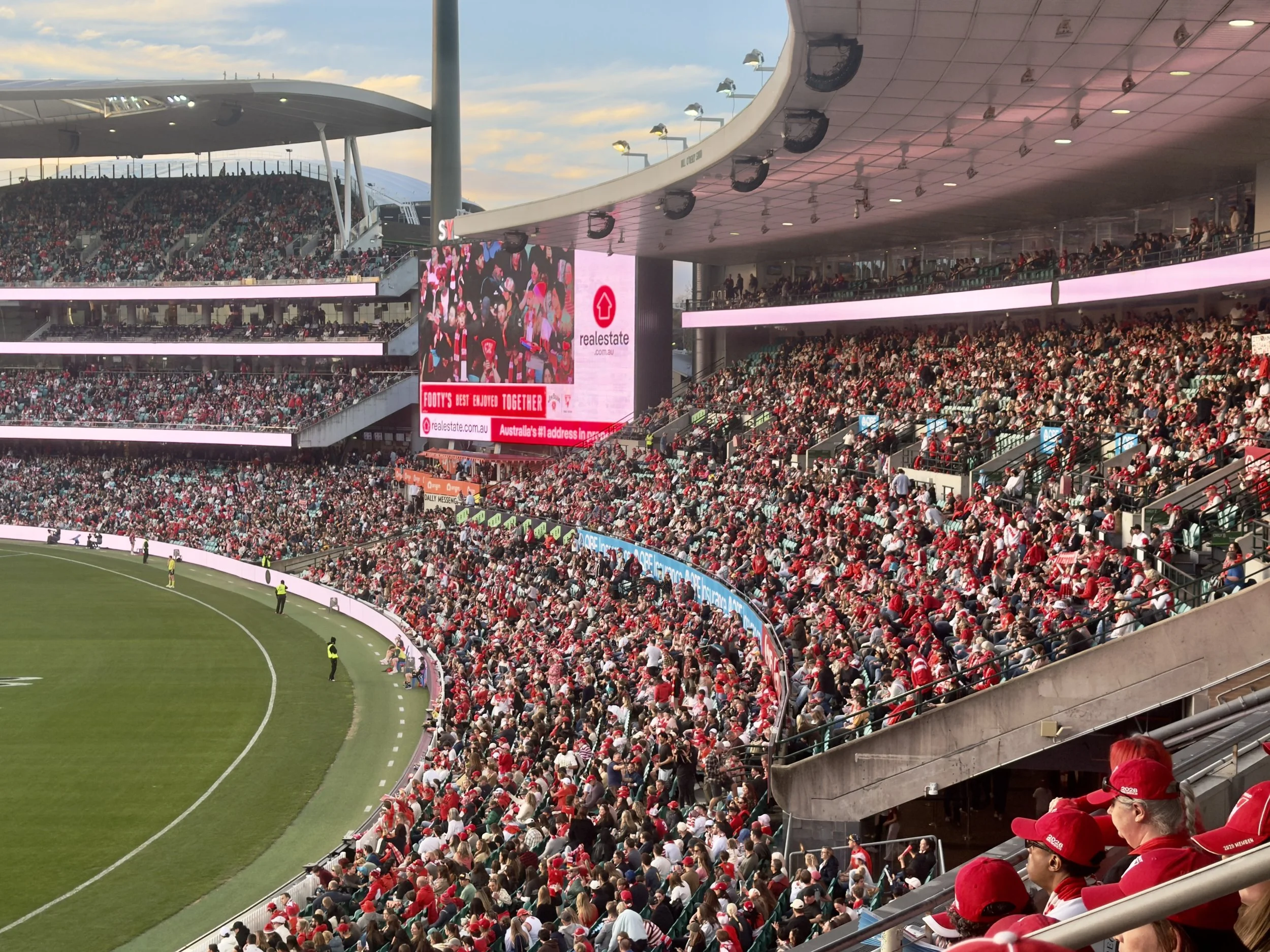
I am writing this while sitting at the SCG, two hours before a Swans game.
The people who arrive this early are not difficult to identify. Almost everyone around me is visibly a Swans supporter. I am wearing a Swans cap and shirt, with a hoodie and scarf ready as the temperature falls. Apart from adding branded shorts and socks, there is not much more I could do to clarify the position.
At this hour, large sections of the SCG are still empty. There is concrete, plastic seating, advertising and architecture. Permanent traces of the home club are everywhere, but the building itself cannot support anyone. It has no anticipation, allegiance or disappointment.
Then the crowd arrives.
One person enters in a scarf. Another has found a red jumper. Someone else wears a cap bought years ago, while a child arrives in the newest guernsey. Individually, each has made a small decision while getting dressed. Together, those decisions begin to change the ground.
The empty seats become red and white. Allegiances become visible. People can see who might share their anticipation, who might tolerate some friendly banter and who will understand the disappointment without needing it explained.
One shirt does not change a sporting event. Neither does one scarf, cap, beanie or jersey. But thousands of them do.
Before the opening bounce, before anyone has kicked a ball, the crowd has already started creating the occasion.
The venue provides somewhere for the match to happen.
The crowd dresses it.