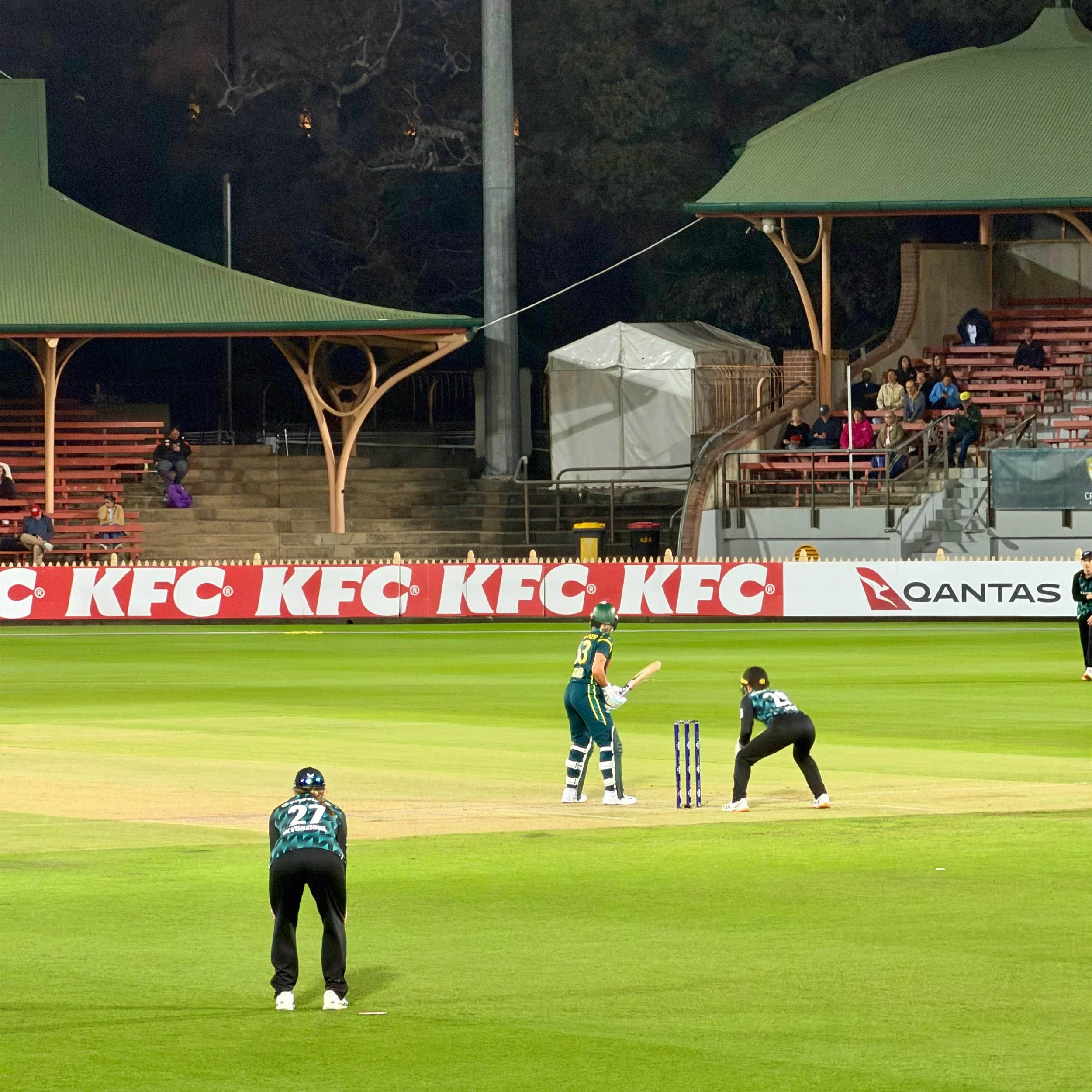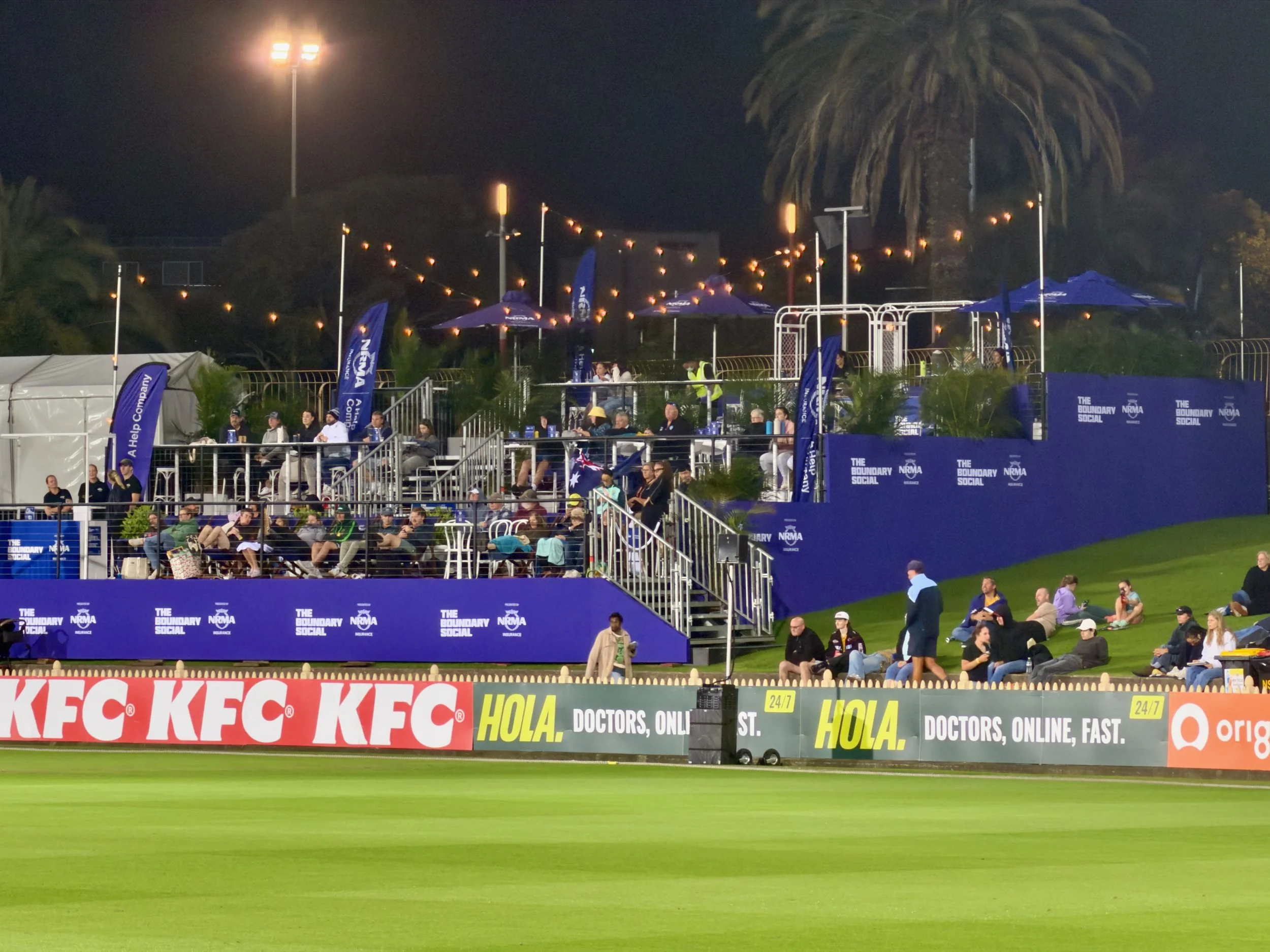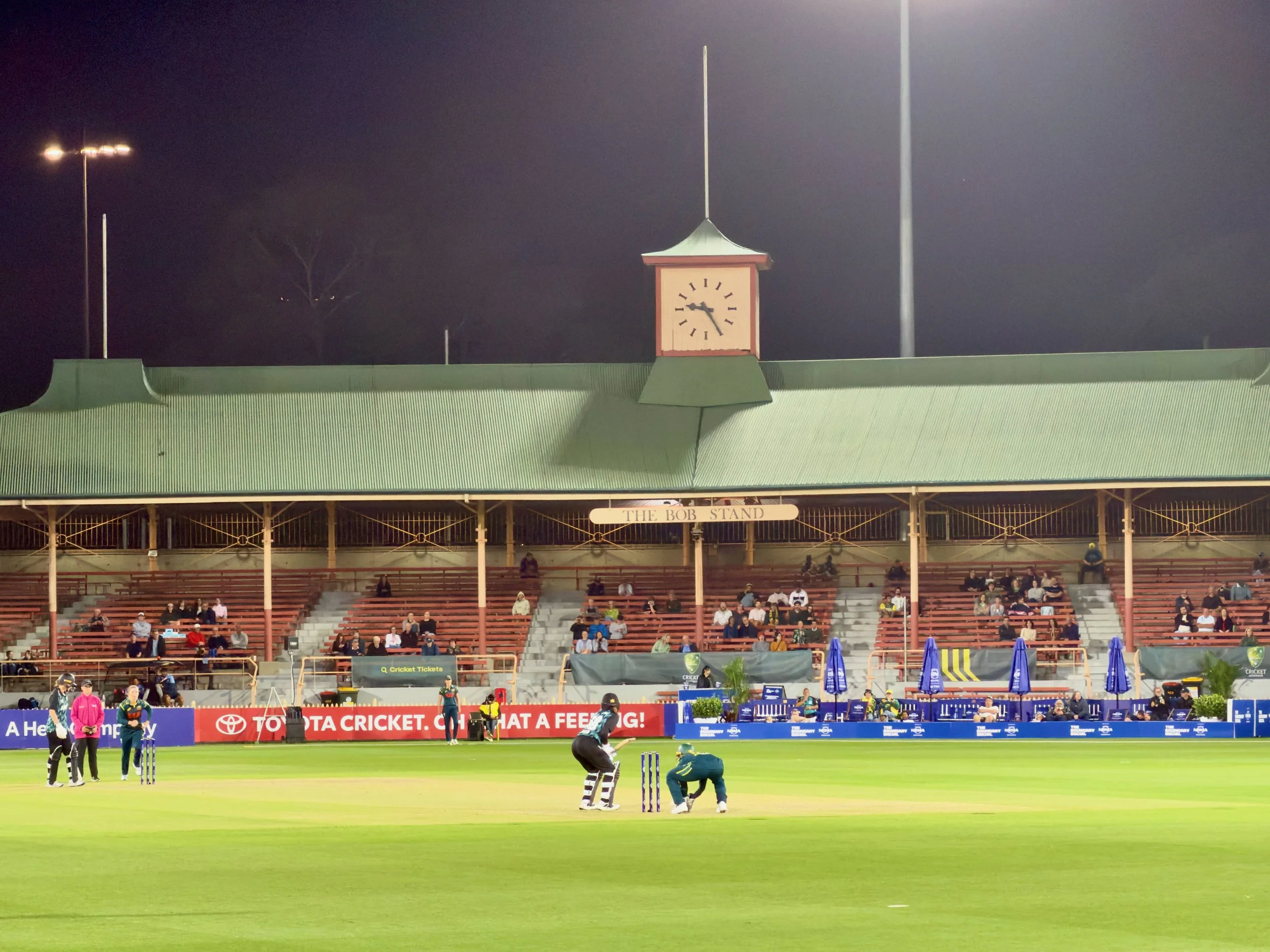

Australia v New Zealand | Women's T20 International | North Sydney Oval | Tuesday 20 October 2026
Another evening at North Sydney Oval. Another cloudless sky, another sunset behind the grandstands, and another women's T20 international between Australia and New Zealand.
I arrived with about half an hour to spare, enough time to find a seat, buy something to eat and settle in. The weather had been beautiful all day, but clear skies and a strong breeze were making it a cool evening. Even the bats that had been so active around the oval on Sunday were noticeably quieter.
The crowd was considerably smaller than Sunday, perhaps around 500 people. There were noticeably fewer children and more older spectators. It was Tuesday evening, with another working and school day ahead.
There was a reasonable contingent of New Zealand supporters too, easily identified by their black clothing. Cricket shirts, All Blacks jerseys, rugby league merchandise. Apparently, any New Zealand sporting allegiance was acceptable.
I suppose that's fair enough. Although I was carrying a Cricket Australia polo shirt in case I got cold, I was wearing my new Sydney Sixers membership cap. Hardly an unmistakable declaration of Australian national loyalty.
I started in my familiar northern stand beside the fig tree.
Australia were batting first, and things didn't begin particularly well. Early wickets made the innings look uncertain before Ashleigh Gardner took control. Her 84 included some magnificent sixes launched into the crowd, drawing cheers, applause and a few audible wows. The inevitable multiple replays on the big screen had everyone watching again, particularly to see whether someone in the crowd had managed a catch. Those attempts generated their own rounds of cheers and applause.
Australia finished on 167/7. A reasonable total, although outside Gardner's contribution the batting had never looked particularly convincing.
At the break, I decided to move. Partly for a different perspective, partly for more food, and partly because sitting still in the cold wind wasn't doing much for my knee. Walking around helped warm me up, and I eventually settled on the southern side of the ground.
New Zealand had pushed Australia on Sunday, and there was reason to wonder whether they might do it again. Australia had won ten consecutive T20 internationals against them. Would tonight make eleven, or could New Zealand finally grab one back?
For a while, there was at least the possibility of a contest.
New Zealand started slowly, but they weren't losing wickets particularly quickly either. The scoreboard kept ticking along, and I found myself watching the required run rate more than the actual score.
Eight an over became eight and a half, then nine, ten, eleven and eventually twelve.
In T20 cricket, twelve runs an over with six or seven overs remaining isn't necessarily impossible. A couple of batters finding their rhythm can change everything very quickly. Even when the numbers look ridiculous, there's often still the possibility of something extraordinary.
I kept waiting for New Zealand to explode into life.
Instead, they lost more wickets.
The new batters at least showed some willingness to attack, but the acceleration never really arrived. Australia weren't flawless either, dropping several catches and offering opportunities New Zealand couldn't exploit.
With New Zealand's chances fading, I found myself paying more attention to the Australian fielders between deliveries.
Every change of batter or bowler seemed to set off another rearrangement. Some fielders moved barely ten or twenty metres, while others travelled halfway around the ground to take up their next position. Watching it from above must be rather like watching a collection of gears rotate and realign.
We regularly hear commentators talk about teams studying individual players and developing specific plans. Watching the Australian fielders continually reposition themselves, sometimes after almost every ball, gave those comments a little more meaning.
I continued moving around the southern side of the ground, spending a few overs behind the television camera while eating, before changing positions again near the sightscreen.
My final position was just metres from one of the flame machines that fired whenever someone hit a boundary or took a wicket.
By this stage, I was getting rather cold.
I found myself desperately hoping for a four, a six, or even another dismissal, if only for a brief burst of warmth from the flames.
Unfortunately, New Zealand weren't providing enough of any of them.
There were occasional moments worth watching. One particularly unusual run-out came when Georgia Wareham deflected a straight drive onto the stumps, catching Maddy Green outside her crease. New Zealand also managed a little more aggressive batting towards the end, but too late to make much difference.
They eventually finished on 127/8, losing by 40 runs. Australia had secured the three-match series with a match still to play.
People had begun leaving during New Zealand's innings, particularly those with younger children. By the end, perhaps only a third to half of the already small attendance remained. With the match finishing around 10:20 pm, I wasn't hanging around for the presentations either.
At one point I'd even plugged in my headphones to listen to the Australian men's Test match against South Africa while watching the women play T20 cricket in Sydney. My own little double-header.
And with the Sydney Sixers qualifying for Wednesday's Spring Challenge final, followed by the third Australia–New Zealand international on Thursday, this was also the first of three consecutive evenings at the cricket.
A double-header inside a triple-header.
I headed for the station, still wondering about the scheduling. It was already after 10:20 pm, and even living in Hornsby, I wasn't expecting to get home until after 11:30. What about people travelling from further away?
Three women's internationals at North Sydney Oval, all on evenings before work or school days. Sunday, Tuesday and Thursday. Why?
A Sunday afternoon match, followed by Wednesday and Friday evenings, would have offered some variety and given families and working spectators more opportunities to attend. I wondered how many people had left early because of the late finish, and how many had decided not to attend at all.
There's one more match to come, now a dead rubber. I've got a ticket.
Hopefully New Zealand find a few more boundaries. If nothing else, I'd appreciate the warmth.