

Sydney International Darts Cup #15 - Australia v New Zealand
Bondi Bowling Club, 23 October 2026
I've thrown darts before. Like plenty of families, we had a dartboard when I was growing up. I knew you threw three darts, tried to hit the highest numbers and occasionally managed to get one somewhere near the bullseye. What I didn't know was how little I actually understood about the game.
With a Friday evening free and an opportunity to watch two of Australasia's leading darts players, I bought a ticket to the Sydney International Darts Cup at Bondi Bowling Club. It was a new sport for me to attend, and I wasn't entirely sure what to expect.
The event was organised by Sydney Darts Club, bringing together Australia's Raymond "The Guru" Smith and New Zealand's Ben "Big Rigg" Robb. Both were introduced as professionals and among the leading players in their respective countries. Alongside them were experienced local and regional players, each getting an opportunity to challenge the professionals.
It wasn't quite the traditional tournament I had imagined. More of an exhibition, with competitive darts, a little showmanship and plenty of audience involvement. And beer. Quite a lot of beer.
An Ordinary Friday Night
Bondi Bowling Club is tucked away among the houses of North Bondi. Despite being in Bondi, it's hardly the glamorous image that the suburb sometimes suggests. It's an older suburban club, surrounded by residential properties.
Arriving around 6.30 pm, there were people playing barefoot bowls, others having dinner and the usual collection of friends and families enjoying a Friday evening. There were tennis courts as well, adding another layer to what was clearly a local sporting and social club.
I found a comfortable seat, ordered a club sandwich and watched people playing bowls through the window while waiting for the darts to begin. The sandwich was excellent, incidentally.
I'm not much of a drinker, so spending a Friday night at a pub or bowling club isn't something I'd normally go out of my way to do. But there was something rather comfortable about this place. People were simply going about their usual Friday evening, while another group was gathering inside for a darts competition.
Walk This Way
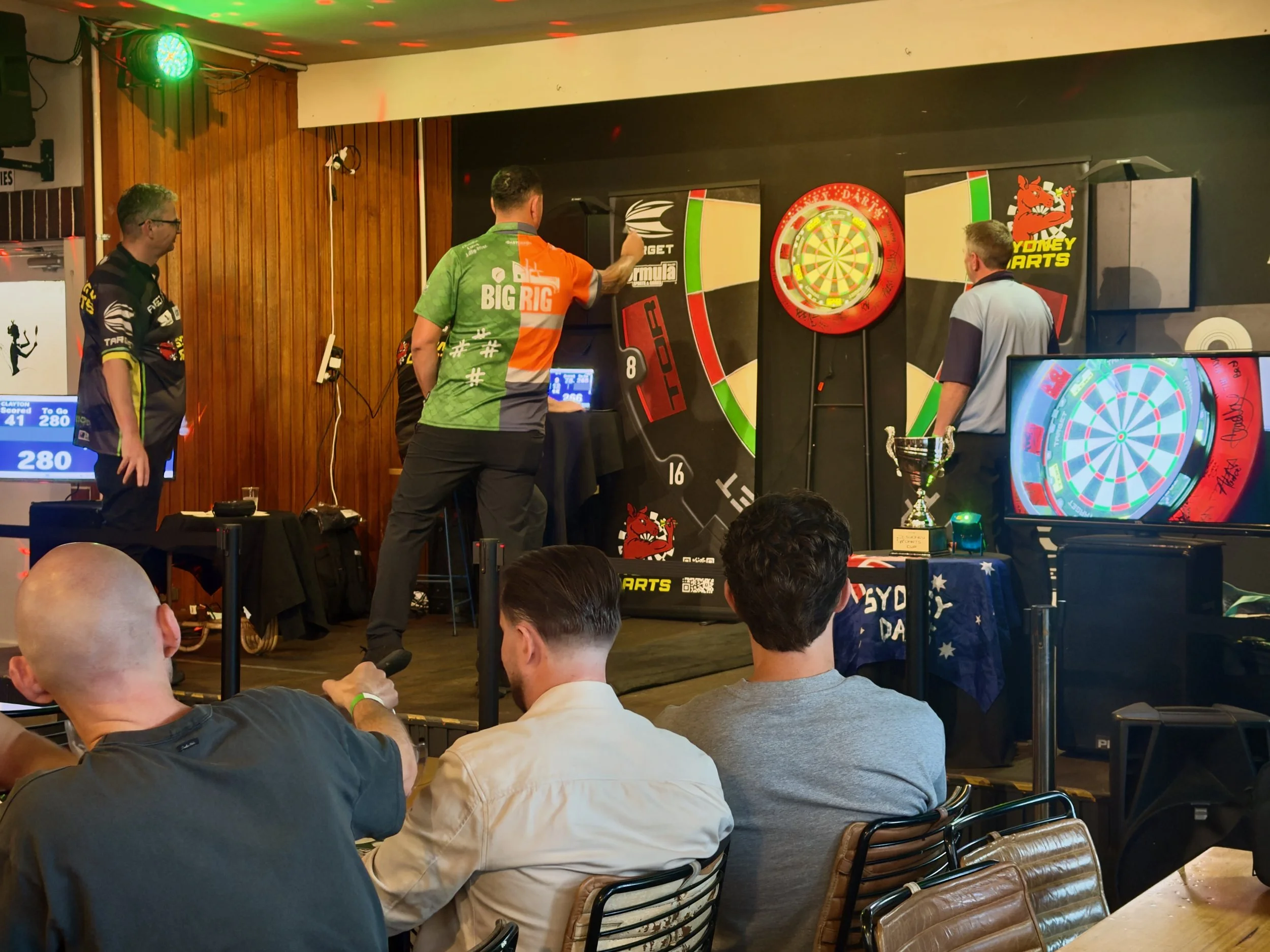
Once the event began, it became clear that darts has rather more in common with boxing than I had expected. Not the physical contact, obviously. The introductions.
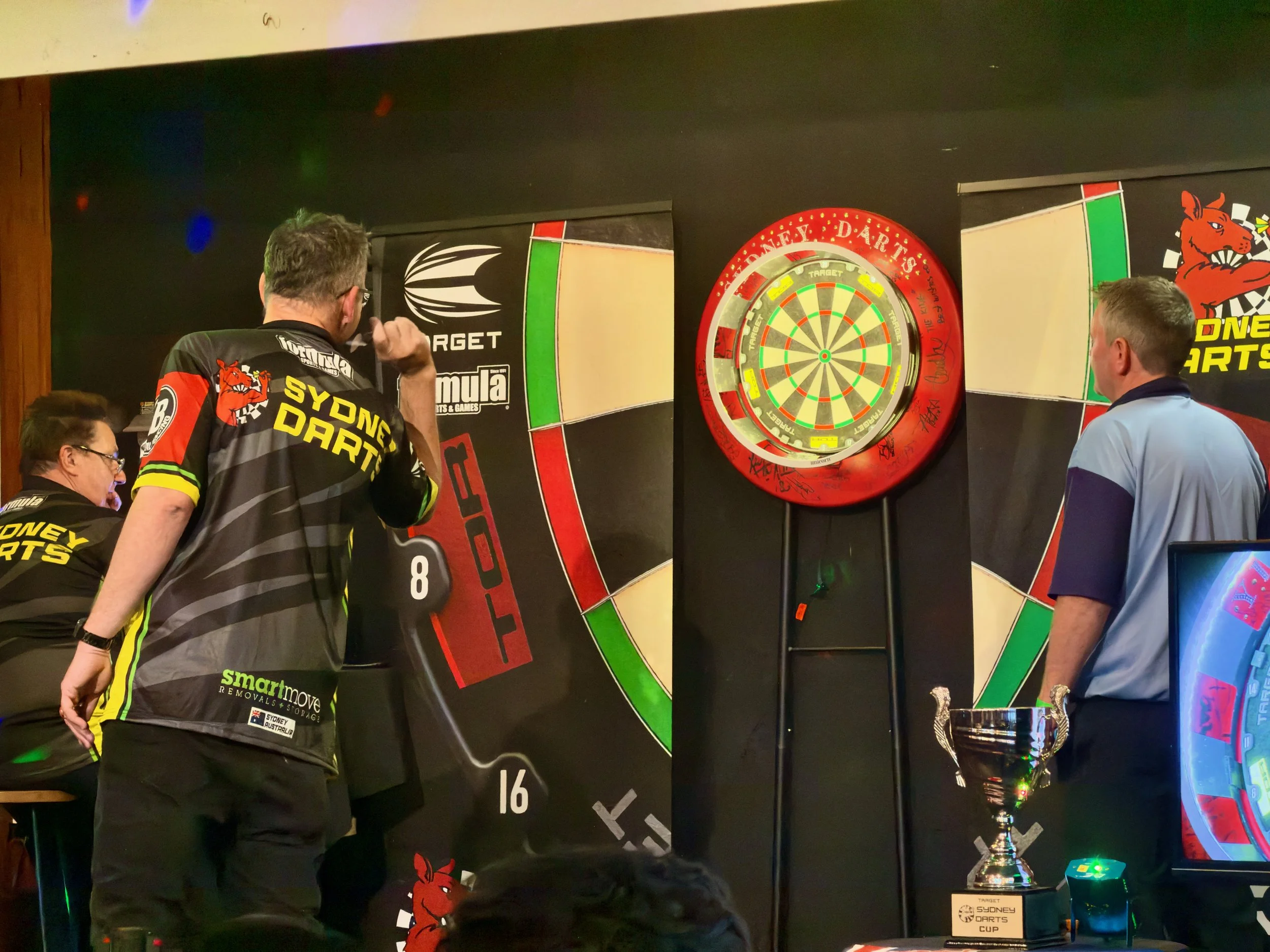
Each player had a nickname, an announcement and, in several cases, their own entrance music. They walked through the audience towards the stage, clapping hands, acknowledging friends and occasionally stopping for photographs. Some carried a beer.
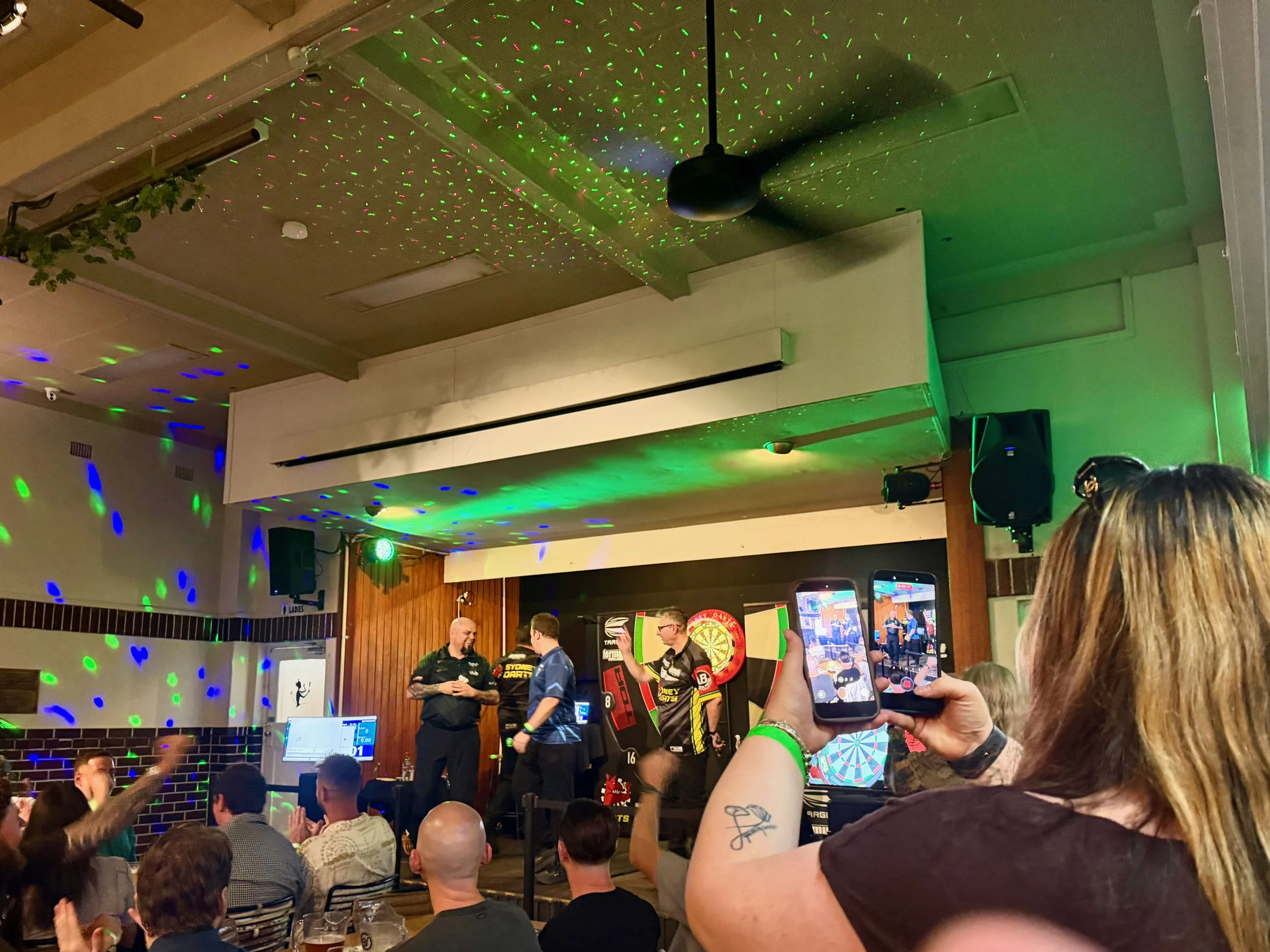
There was plenty of laughter, cheering and good-natured encouragement. A few entrance songs were clearly familiar to the audience, with people anticipating them before they even started playing. It was all rather theatrical, but it also felt genuine.
These weren't anonymous competitors walking onto a professional sporting field. Many were clearly known to the people sitting around the tables.
The room held perhaps a hundred spectators, with most seated in groups of up to eight. My general admission ticket was something of an exception among the tables of friends and supporters. I suspected quite a few people had come along because they knew one of the players, belonged to a darts club or had been invited by someone who did.
I was probably among the few who had turned up without any connection to the sport.
The atmosphere was relaxed and occasionally rowdy, but once the darts were being thrown, there was no doubt the players took their competition seriously.
Closing In
It didn't take long to work out the basic rules. Each player starts with 501 points and throws three darts at a time, subtracting their score until they reach exactly zero. The catch is that the winning dart must land in a double. So, with 40 remaining, a player needs double 20. With 16 remaining, double eight. The inner bullseye is worth 50 and can also finish a game.
Simple enough once you understand it, although I did get my phone out during a break to check the rules, ask a few dumb questions and test some scoring scenarios.
The audience was several steps ahead of me. People reacted to particular scores, sometimes before I had even worked out what had happened. A score of 100 earned some recognition, while a 140 attracted considerably more attention. But the big one was 180.
Three darts into the treble 20, giving the maximum possible score. The announcer had a particular voice reserved for it, delivering the number with the enthusiasm of someone announcing a heavyweight boxing champion. Even the tables had sheets of paper printed with 180, ready to be waved whenever someone achieved it.
It happened often enough throughout the evening, but remained something worth celebrating.
What surprised me, though, was that scoring 180 wasn't necessarily what separated the professionals from the other players. It was what happened at the other end of the game.
Most of the challengers could throw darts remarkably well. They regularly scored hundreds, sometimes 140, and occasionally even 180. Watching them, it was easy to understand why they had been selected to compete. But once the scores dropped below 100, the difference in ability became much more obvious.
The challengers could get close to winning and then struggle to land the final double. They might need 40, miss double 20 and spend another couple of visits trying to finish. Meanwhile, Smith and Robb would often reach a suitable number and close the game out almost immediately, sometimes with their first dart.
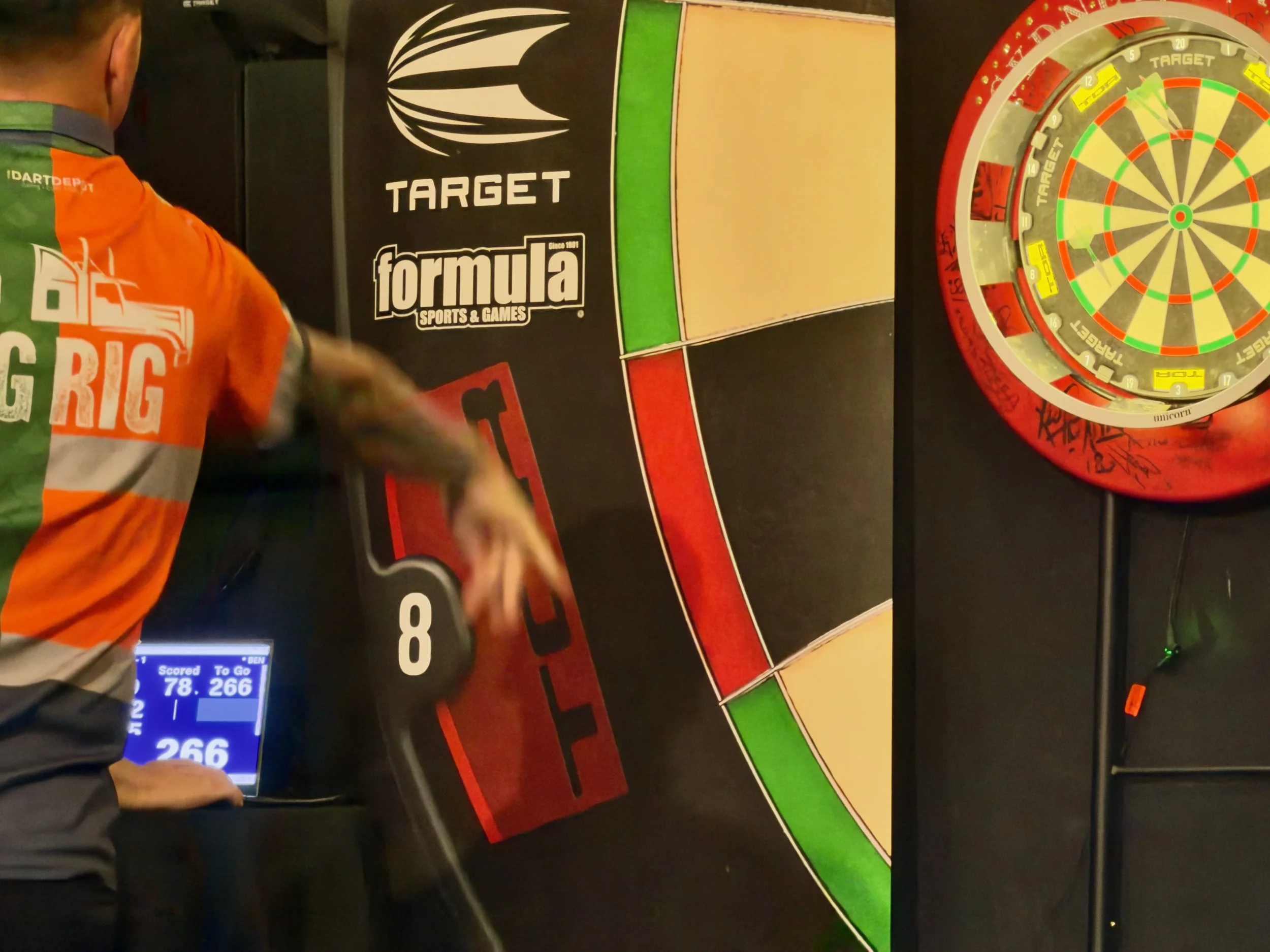
I also found myself spending more time watching the scoreboard. As the scores came down, it became apparent that the professionals weren't always trying to score as many points as possible. They were positioning themselves for a finish, sometimes apparently choosing a lower score to leave a particular number for their next visit. It wasn't simply about getting closer to zero. It was about getting there in a way that gave them the best opportunity to finish, preferably with options if the first dart missed.
For most of the evening, there was constant conversation. People were eating, drinking, laughing and talking among themselves. The players seemed entirely comfortable with it. Then, occasionally, the room would become remarkably quiet.
Usually when one of the professionals was approaching a finish.
Conversations stopped, people watched more closely and sometimes someone would shush those who hadn't noticed what was happening. It wasn't complete silence, but the contrast was striking.
At first, I wasn't quite sure what was causing it. But as I began to understand the scoring and started paying more attention to the scoreboard, I began recognising the moments myself. One of the professionals would be setting up a finish, the crowd would become quieter, and within a handful of darts the game was usually over.
There was something almost inevitable about it. You could see the professionals working their way towards a particular finish, arranging their remaining score and then delivering the dart they needed. The challengers might have been throwing some excellent darts, but once the professionals reached that final stage, there was rarely much time left.
Then the winning double would land, the crowd would react, and normal conversation would resume.
It was a fascinating rhythm, and the more I understood what was happening, the more impressive it became.

More Than Meets the Eye
Darts also challenges some of the usual assumptions about what a professional athlete looks like. The players came in all shapes and sizes. Robb was tall and solidly built, someone who could easily have been mistaken for a rugby league player. Others were closer to the size of a jockey. In most sports, those two body types wouldn't be competing against each other. In darts, they can compete at the same level.
What mattered was control. Each player had a slightly different stance and throwing style. Robb occasionally moved sideways before throwing, apparently adjusting his angle when darts were already occupying part of the board. At least, that was my interpretation.
The speed and rhythm of the competition were equally interesting. Three darts, retrieve them, move aside, next player. There was very little wasted movement, and the players were clearly accustomed to the routine.
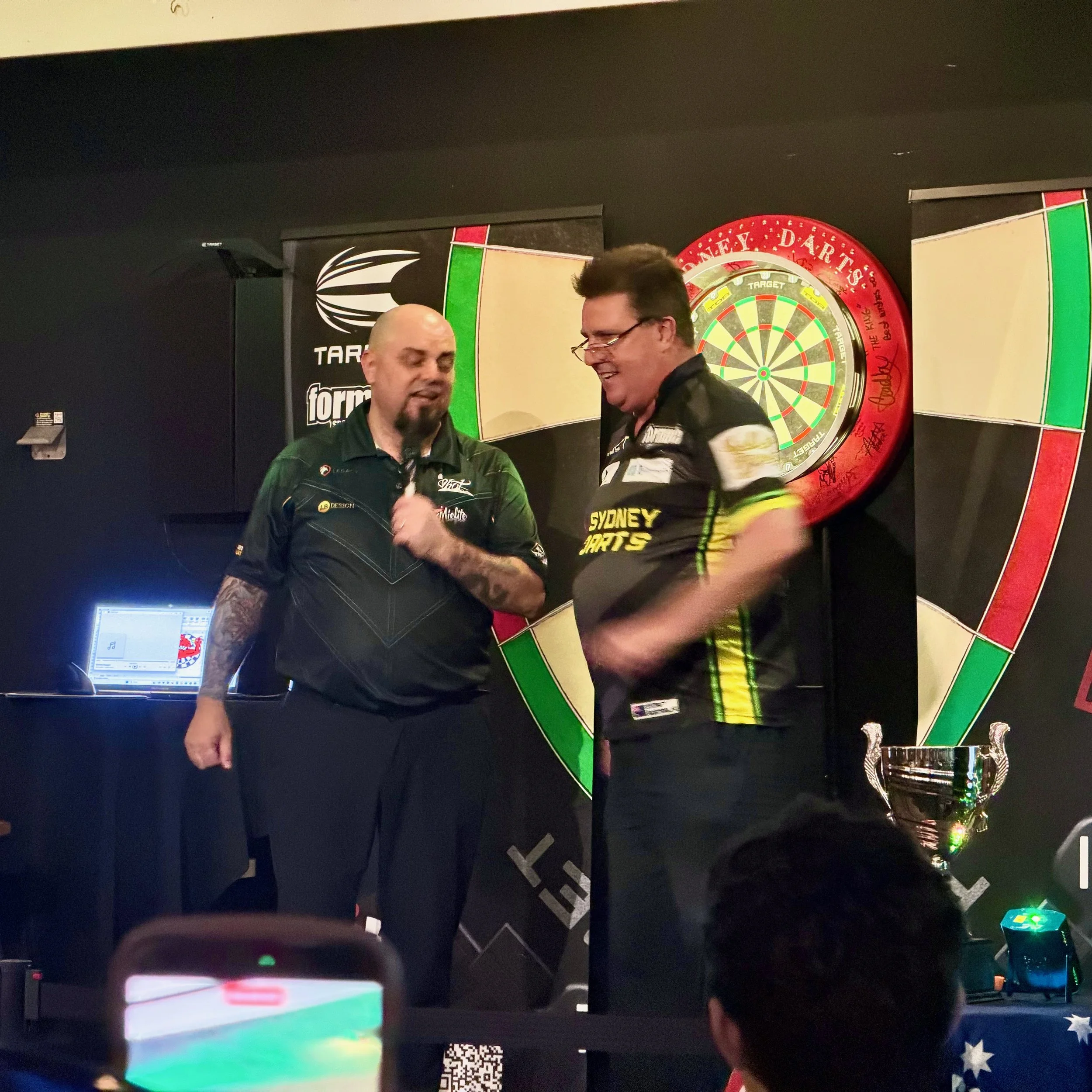
A small stage had been set up at one end of the room, with the dartboard, lighting and a television screen showing a close-up of the action. Spectators could watch the players directly or follow the darts on the screen. I found myself alternating between the two, sometimes watching where the dart landed and at other times concentrating on the player throwing it.
The challengers generally played best-of-three contests against the professionals, with the leading challengers eventually competing for the Sydney Darts Cup. The final attraction was Smith against Robb in a best-of-seven contest, with the New Zealander coming out on top.
By then, I'd spent several hours watching darts and was beginning to wonder what a larger professional tournament would be like. The entrance music, the nicknames, the announcer and the crowd reacting to a 180 were all familiar elements from televised darts, although experiencing them in a small club was something quite different.
As I was leaving, a signed jersey was being auctioned, with bidding already above $250. Most of the crowd had stayed throughout the evening, and there was still plenty of conversation taking place around the tables.
For many people, it had simply been a Friday night out with friends. They'd booked a table, ordered dinner, had a few drinks and watched some excellent darts. The competition was the entertainment, but the social gathering was just as important.
Worth Another Throw?
Would I go again? Possibly. There was talk of another event in January, potentially featuring a professional player from Europe. If I did return, I'd probably do it differently. I'd bring some friends, book a table and make a Friday night of it.
I'd also be interested in seeing a larger tournament and how the atmosphere compares.
I arrived knowing very little about competitive darts. By the end of the evening, I was beginning to recognise those moments before the dart had even been thrown.